
shell
Guest
benducket3211@gmail.com
Is a 3D Microscope the Future of Advanced Scientific Imaging and Precision Analysis? (4 views)
18 Jun 2026 23:05
A 3D Microscope is an advanced optical and digital imaging instrument designed to provide three-dimensional visualization of microscopic objects with exceptional clarity and depth accuracy. Unlike traditional microscopes that display flat two-dimensional images, a 3D Microscope allows users to observe surface structures, textures, and spatial relationships in a realistic three-dimensional format. This makes it an essential tool in scientific research, industrial inspection, medical diagnostics, and electronic engineering.
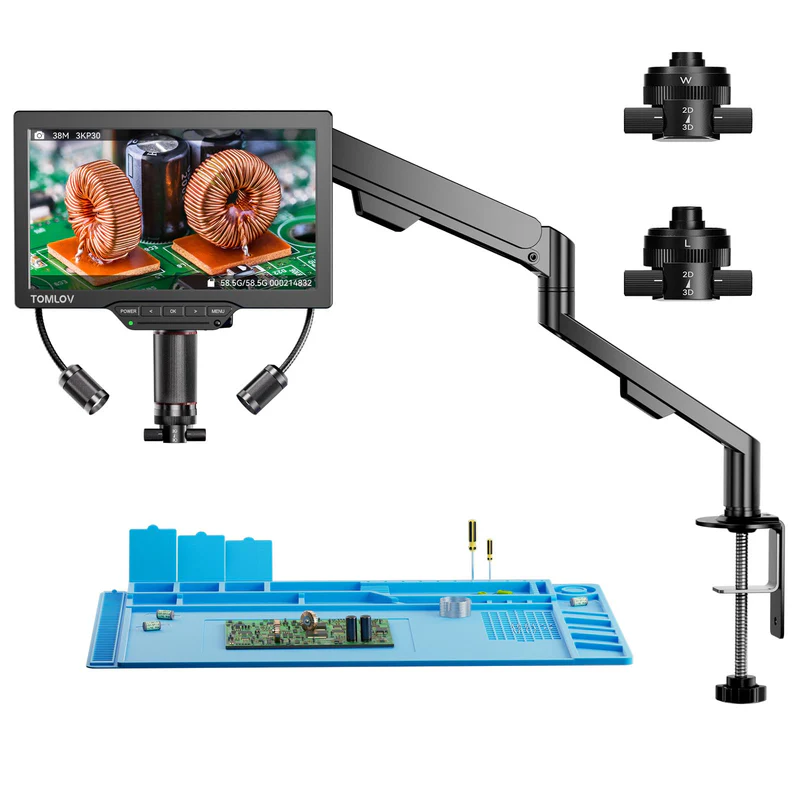
With the rapid growth of nanotechnology, biotechnology, and precision manufacturing, the demand for high-resolution 3D imaging systems has increased significantly. A modern 3D microscope combines advanced optics, digital sensors, and software-based reconstruction techniques to deliver detailed and accurate 3D representations of microscopic samples. These systems help researchers and professionals analyze complex structures that cannot be properly understood using conventional microscopy.
3D Microscope Imaging Technology
A 3D Microscope uses sophisticated imaging technologies such as stereo vision, focus stacking, and digital reconstruction to create three-dimensional views of microscopic objects. Instead of capturing a single flat image, the system collects multiple images from different angles and depth levels, combining them into a single 3D model.
High-resolution optical lenses and digital sensors play a major role in producing sharp and accurate images. Advanced software then processes these images to reconstruct surface depth, texture variation, and structural details. This technology allows users to rotate, zoom, and analyze microscopic samples from different perspectives, providing a far more comprehensive understanding than traditional microscopy.
Modern systems also include LED illumination and contrast enhancement features that improve visibility and highlight even the smallest structural differences on a sample’s surface.
Scientific Research Applications
A 3D Microscope is widely used in scientific research fields such as biology, chemistry, materials science, and nanotechnology. In biological research, it allows scientists to examine cells, tissues, and microorganisms in three dimensions, helping them understand complex biological structures and processes.
In materials science, 3D microscopy is used to study surface morphology, fracture patterns, and material composition at microscopic levels. Researchers can analyze how materials respond to stress, temperature changes, and environmental conditions by observing their internal structures in detail.
Nanotechnology research also relies heavily on 3D microscopes, as they provide the ability to visualize and manipulate structures at the nanoscale. This level of precision is essential for developing advanced materials, electronic components, and biomedical innovations.
Industrial Inspection and Manufacturing Use
In industrial environments, a 3D Microscope plays a crucial role in quality control and inspection processes. Electronics manufacturers use it to inspect printed circuit boards, semiconductor chips, and microelectronic components for defects, alignment issues, and manufacturing errors.
The ability to visualize components in three dimensions allows engineers to detect surface irregularities, soldering defects, and structural inconsistencies with high precision. This helps ensure that products meet strict quality standards before reaching the market.
In automotive, aerospace, and precision engineering industries, 3D microscopes are used to inspect small mechanical components where even minor defects can affect performance and safety. This makes them indispensable tools in modern manufacturing systems.
Medical and Biomedical Imaging
A 3D Microscope is also highly valuable in medical and biomedical fields. It enables doctors and researchers to study cells, tissues, and biological samples in a more realistic three-dimensional format, improving diagnostic accuracy and research outcomes.
In pathology, 3D imaging helps identify abnormalities in tissue structures that may not be visible in traditional microscopy. This contributes to more accurate disease diagnosis and better understanding of disease progression.
Biomedical researchers use 3D microscopes to analyze cell behavior, drug interactions, and genetic structures. The detailed visualization helps in developing new treatments and improving medical technologies.
Digital 3D Microscope Systems
Modern 3D Microscope systems are often integrated with digital technology, allowing users to view and analyze samples on computer screens or digital displays. These systems provide enhanced flexibility and advanced data processing capabilities.
Digital 3D microscopes enable image capture, storage, and sharing for collaborative research and documentation. Advanced software tools allow users to measure distances, analyze surface profiles, and generate accurate 3D models of microscopic structures.
This digital integration makes 3D microscopy more efficient and accessible for laboratories, educational institutions, and industrial facilities.
Optical Depth and Precision Imaging
One of the most important advantages of a 3D Microscope is its ability to provide accurate depth perception. Unlike traditional microscopes that produce flat images, 3D systems reveal height variations and surface contours with precision.
Stereo imaging techniques use dual lenses to simulate human binocular vision, creating a natural three-dimensional effect. This allows users to understand spatial relationships between different parts of a microscopic object.
Improved depth accuracy is especially important in applications that require detailed surface analysis, such as semiconductor inspection and biological research.
High-Resolution Visualization
A 3D Microscope offers high-resolution imaging that captures even the smallest surface details. This includes micro-cracks, texture variations, and structural imperfections that are critical in scientific and industrial analysis.
High-definition sensors combined with advanced optics ensure that images remain sharp and clear even at high magnification levels. This level of detail allows researchers and engineers to make accurate observations and informed decisions.
The ability to zoom into microscopic structures without losing clarity makes 3D microscopes superior to many traditional imaging systems.
Educational and Training Applications
A 3D Microscope is widely used in educational institutions to enhance learning experiences in science and technology subjects. It helps students visualize microscopic structures in three dimensions, making complex concepts easier to understand.
Interactive 3D imaging encourages better engagement and improves comprehension of biological, chemical, and material science topics. Students can observe cells, minerals, and microstructures in detail, gaining practical knowledge of microscopic analysis.
Training programs in medical and engineering fields also use 3D microscopes to provide hands-on experience with advanced imaging techniques.
Selecting the Right 3D Microscope
Choosing the right 3D Microscope depends on the intended application and required level of detail. Entry-level models are suitable for educational purposes, while advanced systems are designed for research laboratories and industrial inspection.
Key factors such as magnification range, resolution quality, imaging technology, and software capabilities should be carefully evaluated. High-end models offer real-time 3D rendering, advanced measurement tools, and superior image processing features.
Selecting the right system ensures accurate results, improved efficiency, and long-term reliability in various applications.
Conclusion
A 3D Microscope represents a major advancement in microscopic imaging technology, offering three-dimensional visualization that significantly improves analysis, research, and inspection processes. Its ability to provide depth, clarity, and high-resolution imaging makes it an essential tool in scientific research, medical diagnostics, industrial quality control, and education.
From studying biological cells to inspecting semiconductor components and analyzing advanced materials, 3D microscopes deliver unmatched precision and insight. As technology continues to evolve, the 3D microscope will remain a vital instrument in modern science and industry, driving innovation and enhancing our understanding of the microscopic world.
43.242.176.44
shell
Guest
benducket3211@gmail.com